

Riskanalysis
Risk analysis forms the foundation of every Information Security Management System (ISMS). It systematically identifies, assesses and treats risks to information security. Without a sound risk analysis, organizations cannot adequately protect their critical information assets.
Navigation: ISMS → Risk Assessment
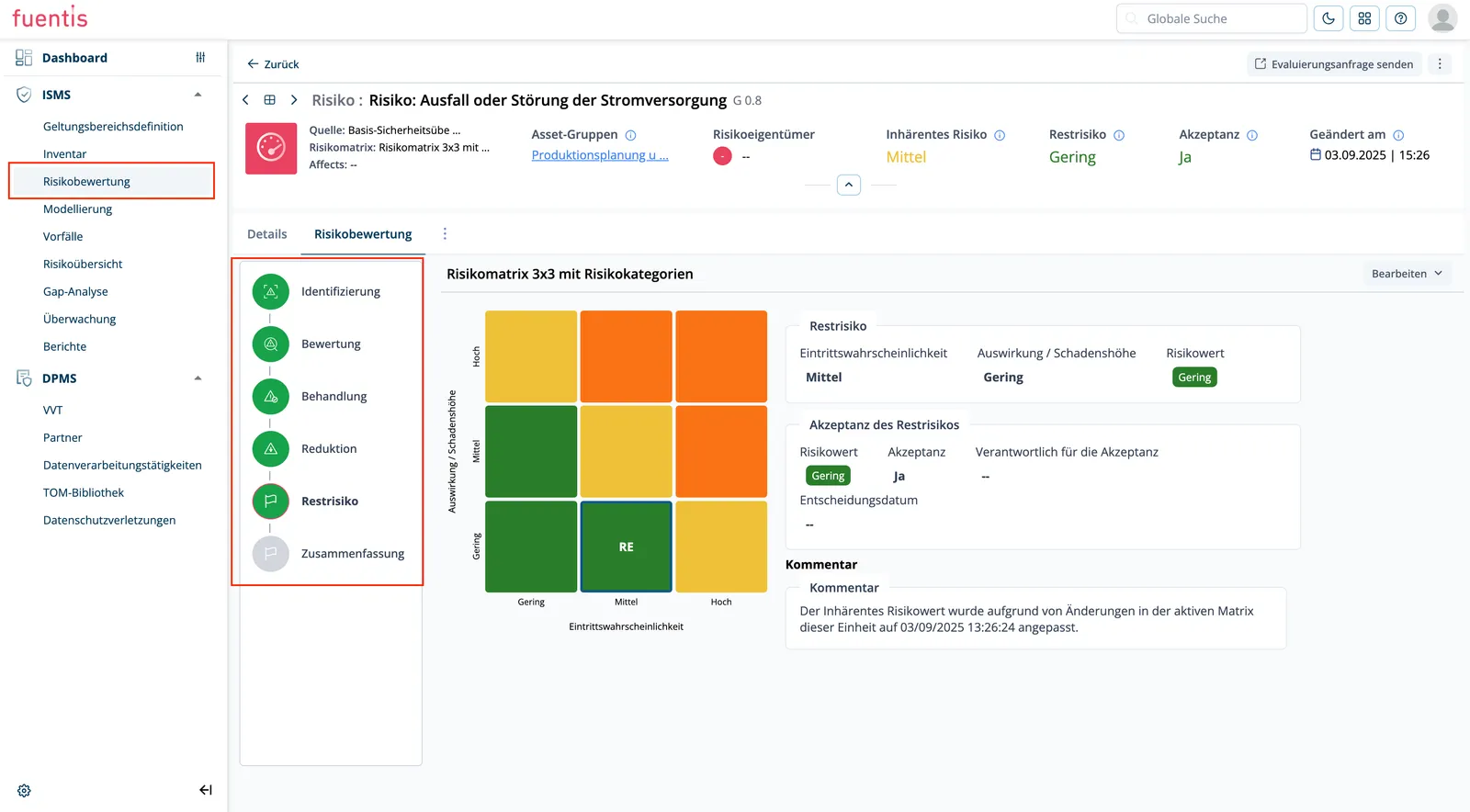
Core Objectives of Risk Analysis
Section titled “Core Objectives of Risk Analysis”- Create transparency: Make potential threats to information assets visible
- Enable prioritization: Focus resources specifically on the greatest risks
- Ensure compliance: Meet regulatory requirements (ISO 27001, BSI IT-Grundschutz)
- Promote proactivity: Switch from reactive to preventive security strategy
Relevance in ISMS Context
Section titled “Relevance in ISMS Context”According to ISO 27001:2022, risk analysis is not optional but a central component of the ISMS. Risk analysis is the basis for:
- The selection of appropriate security measures (Controls from ISO 27001 Annex A)
- The creation of the Statement of Applicability (SoA)
- The continuous improvement of information security
Practice Tip: A risk analysis is particularly necessary when assets have high or very high protection requirements regarding confidentiality, integrity, or availability.
Methodological Approaches: ISO 27001 vs. BSI IT-Grundschutz
Section titled “Methodological Approaches: ISO 27001 vs. BSI IT-Grundschutz”ISO 27001 Approach
Section titled “ISO 27001 Approach”Characteristics:
- Flexible and individual: Organization defines its own methodology
- Risk-based: Continuous assessment and adaptation
- Internationally recognized: Global standard
- Demanding: Requires methodological maturity
Suitable for:
- Internationally operating companies
- Organizations with specific requirements
- Industries with high regulatory requirements (finance, healthcare)
BSI IT-Grundschutz Approach
Section titled “BSI IT-Grundschutz Approach”Characteristics:
- Structured and comprehensive: Predefined modules and threat catalogs
- Layer model: Multiple security levels reduce dependence on precise assessment
- Practice-oriented: Based on proven standards
- Guided: Clear specifications and guidelines
Suitable for:
- German authorities and public administration
- Companies with complex IT landscapes
- Organizations with less experience in risk assessment
Best Practice: Many organizations combine both approaches - use the structure of IT-Grundschutz with the flexibility of ISO 27001.
The Risk Management Process in Detail
Section titled “The Risk Management Process in Detail”1. Asset Identification
Section titled “1. Asset Identification”Objective: Capture every information asset worth protecting, leaving none out
Procedure:
- Inventory: Capture hardware, software, data, processes, and personnel
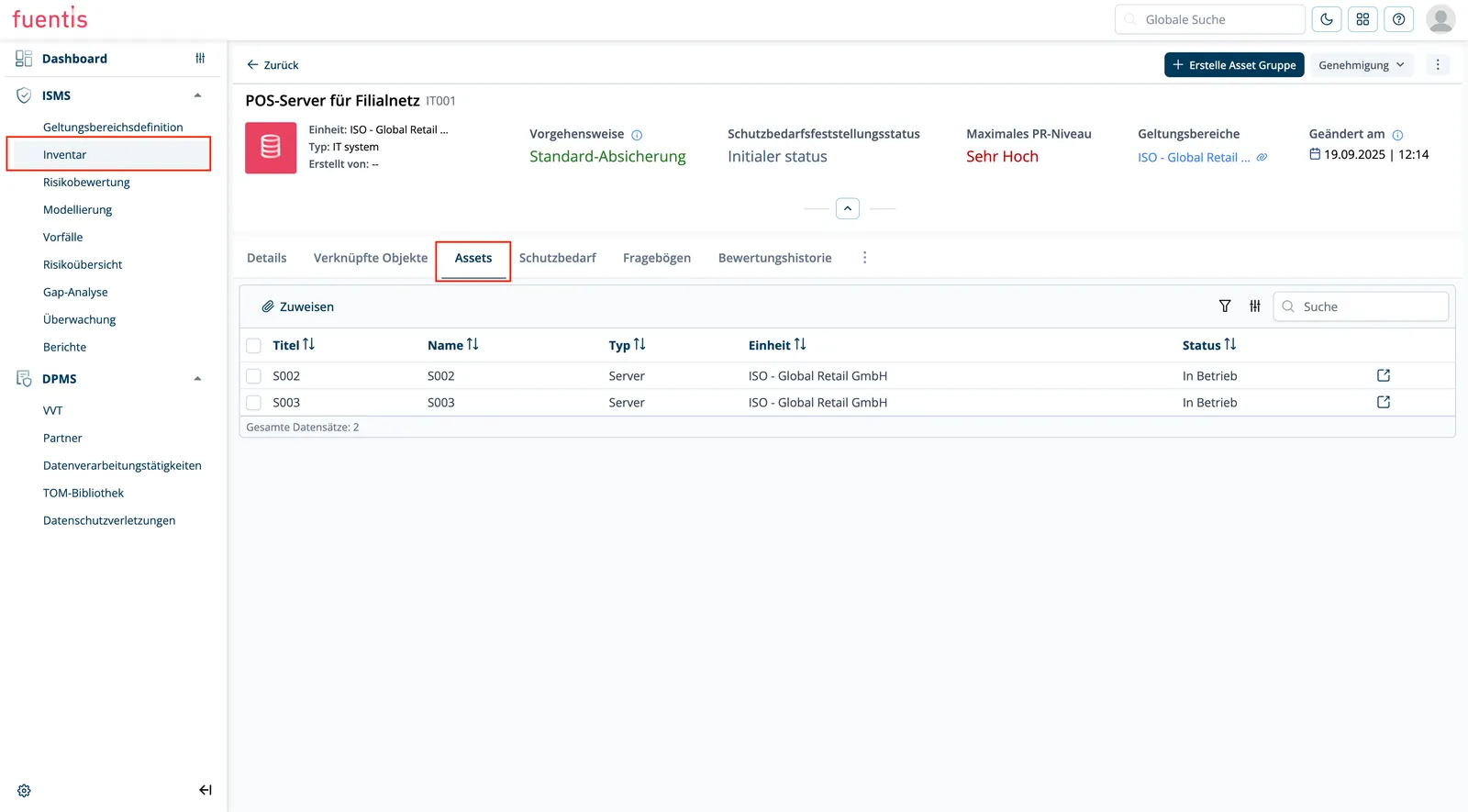
- Grouping: Combine similar assets into Target Object Groups (TOG)
- Classification: Define protection requirements (normal, high, very high)
Practice Example: Instead of evaluating 500 individual servers, they are grouped by operating system, function, or criticality (e.g., “All Oracle Linux Servers - Production”).
2. Risk Identification
Section titled “2. Risk Identification”Objective: Systematically capture threats and vulnerabilities
Components:
- Threats: What could go wrong?
- Vulnerabilities: Where are we vulnerable?
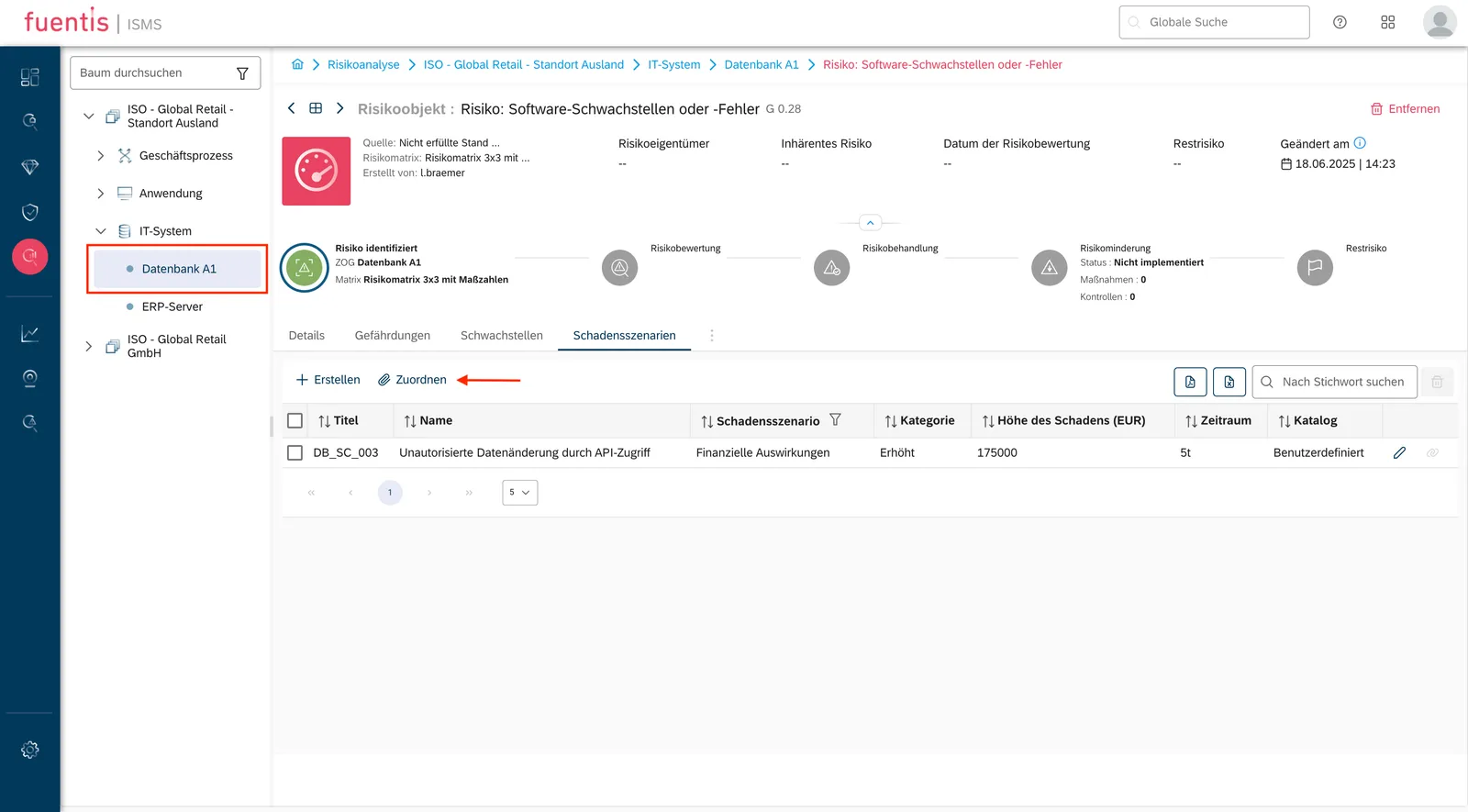
- Damage scenarios: What would be the consequences?
Catalogs and Sources:
- BSI IT-Grundschutz Compendium (Threat catalog)
- CVE databases for technical vulnerabilities
- Industry-specific threat intelligence
3. Risk Assessment
Section titled “3. Risk Assessment”Central Concepts:
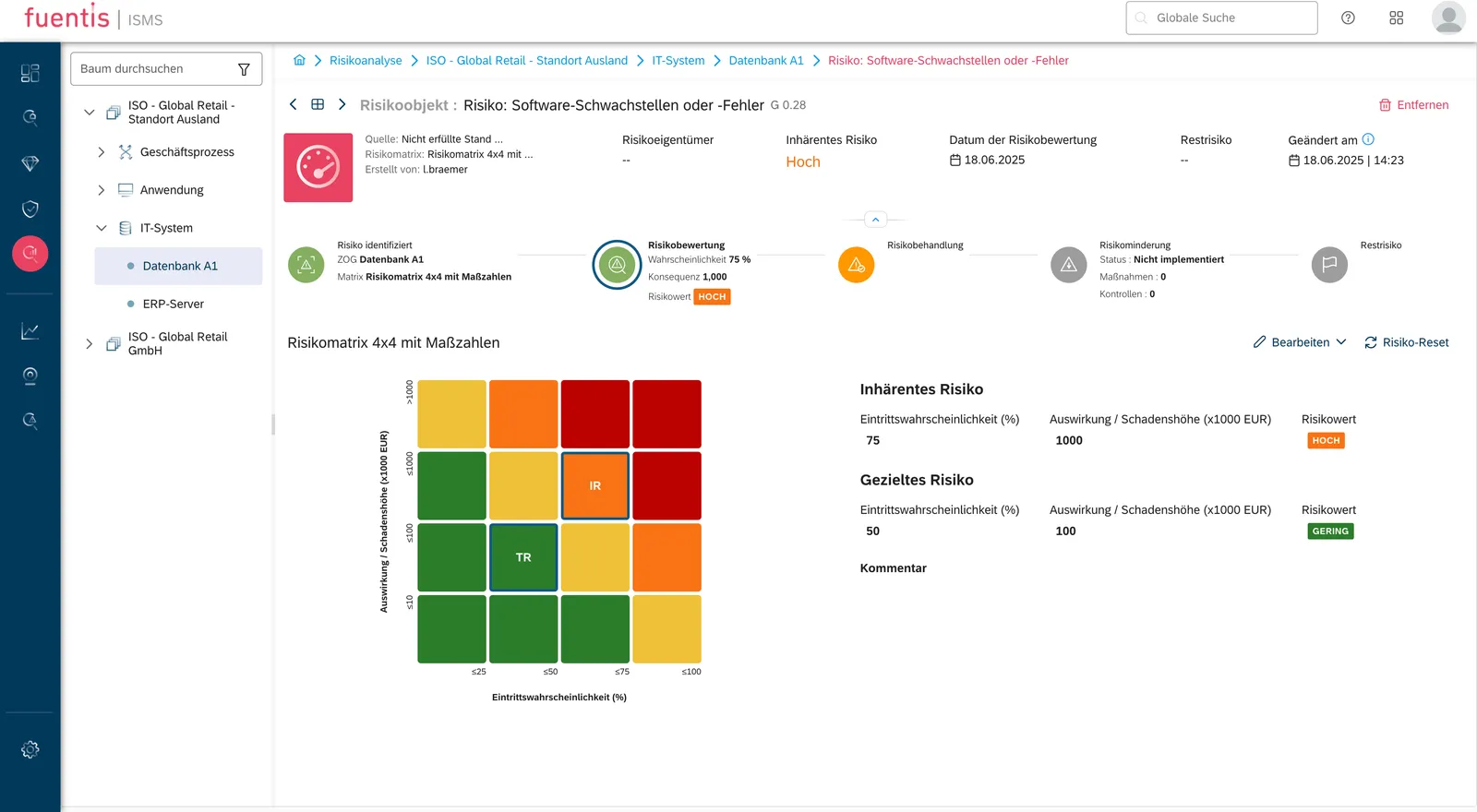
Inherent Risk
Section titled “Inherent Risk”Definition: The risk without any protective measures - the “naked” threat situation.
Example: Unencrypted data transmission during server migration
- Probability of occurrence: High
- Damage potential: €175,000
- Inherent risk: High
Target Risk
Section titled “Target Risk”Definition: The acceptable risk level after implementation of measures - in accordance with the organization’s risk appetite.
Determination based on:
- Regulatory requirements
- Business objectives
- Stakeholder expectations
- Cost-benefit analysis
4. Risk Treatment
Section titled “4. Risk Treatment”Four Strategies:
A. Risk Reduction
Section titled “A. Risk Reduction”- Most common strategy: Implement controls
- Example: Encryption, access controls, monitoring
- Implementation: Select controls from ISO 27001 Annex A
B. Risk Avoidance
Section titled “B. Risk Avoidance”- Stop activity: Eliminate risk source
- Example: Renounce cloud storage of critical data
- When sensible: Risk exceeds any possible benefit
C. Risk Transfer
Section titled “C. Risk Transfer”- Shift responsibility: Insurance or outsourcing
- Example: Cyber insurance, managed security services
- Important: Risk remains, only responsibility is shared
D. Risk Acceptance
Section titled “D. Risk Acceptance”- Conscious decision: Tolerate risk
- Prerequisite: Within risk tolerance
- Documentation: Formal acceptance by management required
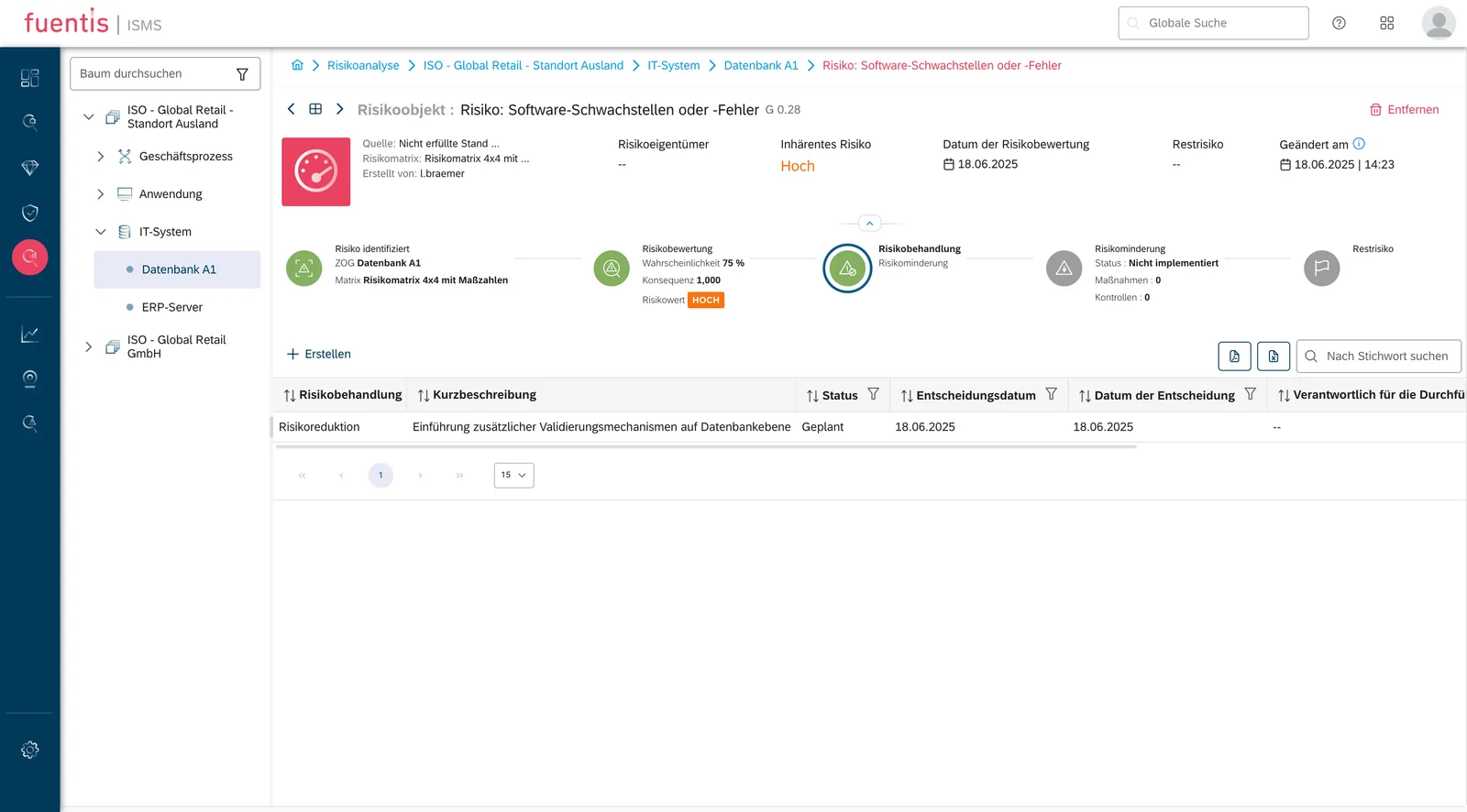
Assigning a control from within the risk
Section titled “Assigning a control from within the risk”Navigation: ISMS → Risk Assessment → open the risk
The measure you mitigate a risk with hangs off the risk itself. The path there is easy to miss:
- Fill in the risk assessment first. Without an assessed inherent risk you cannot create a treatment.
- Under risk treatment, create a treatment, pick the strategy (for example Acceptance) and set the target risk.
- Save.
- In the treatment table, drag the horizontal scrollbar at the bottom to the right. The column with the three-dot menu sits at the far right and is off screen by default.
- Three-dot menu → Add control, pick the control from the catalog, for
example
5.18 Access rights, and assign it.
This assignment does two things at once. The risk belongs to a target object group. Assign a control to the risk and the control is assigned to that group as well, where it shows up in Modeling. You do not have to create it a second time.
Two views on the same assignment
Section titled “Two views on the same assignment”There are two ways to assign a control, and both end up in the same data:
| Route | Starting point | When it fits |
|---|---|---|
| Risk assessment | one specific risk | The control answers an assessed risk. The link to the target object group comes along for free. |
| Modeling | a target object group | The control belongs to the group’s baseline, regardless of any single risk. |
Which one you pick is a question of direction, not of outcome. Risk-driven you work from the threat to the measure; in modeling you work from the object to the measure.
Tracking implementation
Section titled “Tracking implementation”Implementation status belongs on the control, not on the risk. Open the control, Edit, set the status to Implemented, Save. Only that step moves the gap analysis.
5. Residual Risk Management
Section titled “5. Residual Risk Management”Definition: The remaining risk after implementation of all measures.
Process:
- Assess effectiveness of implemented controls
- Recalculate residual risk
- Compare with target risk
- If necessary, take further measures or formally accept
Practice Tip: Residual risk is never zero - it’s about an acceptable level, not perfection.
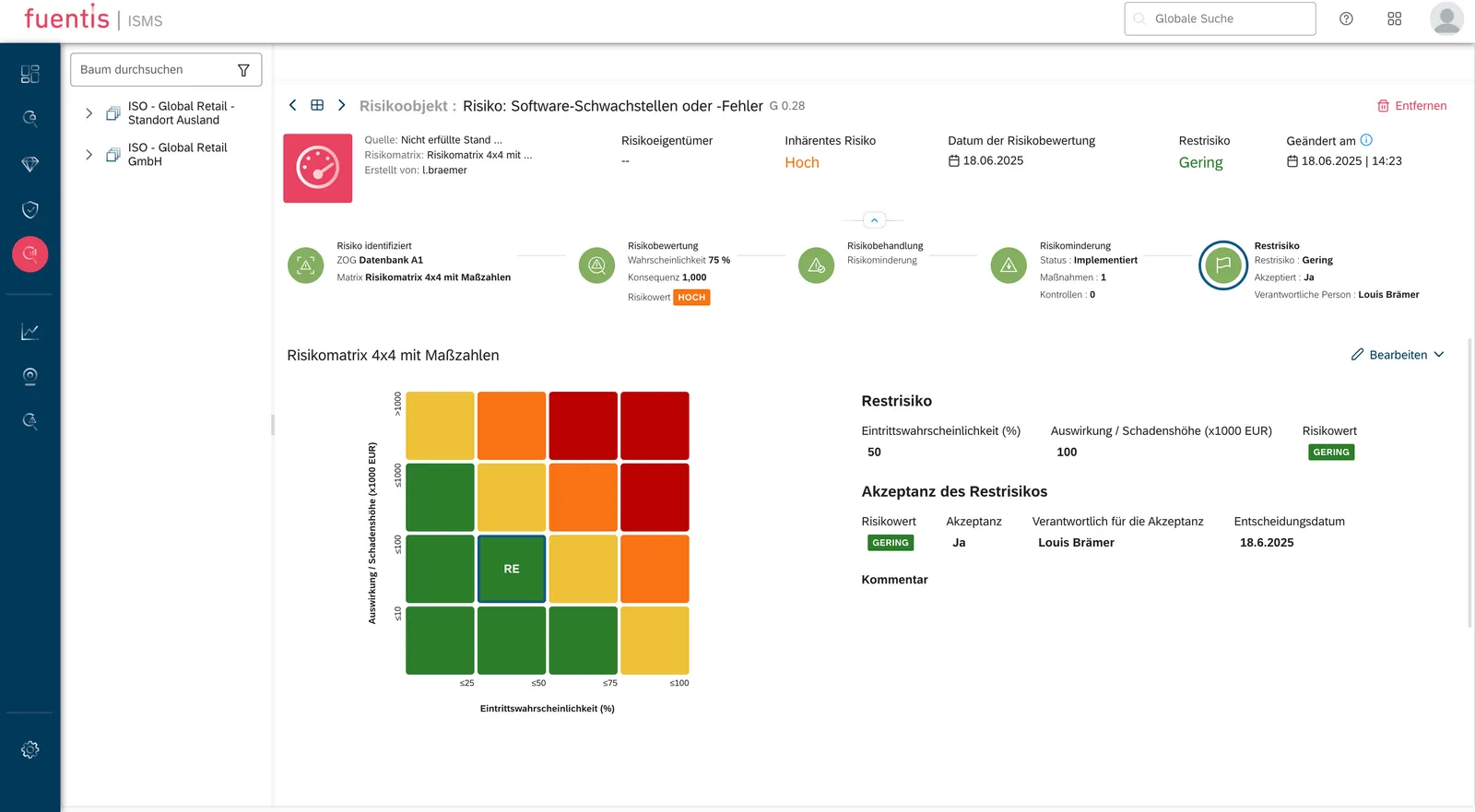
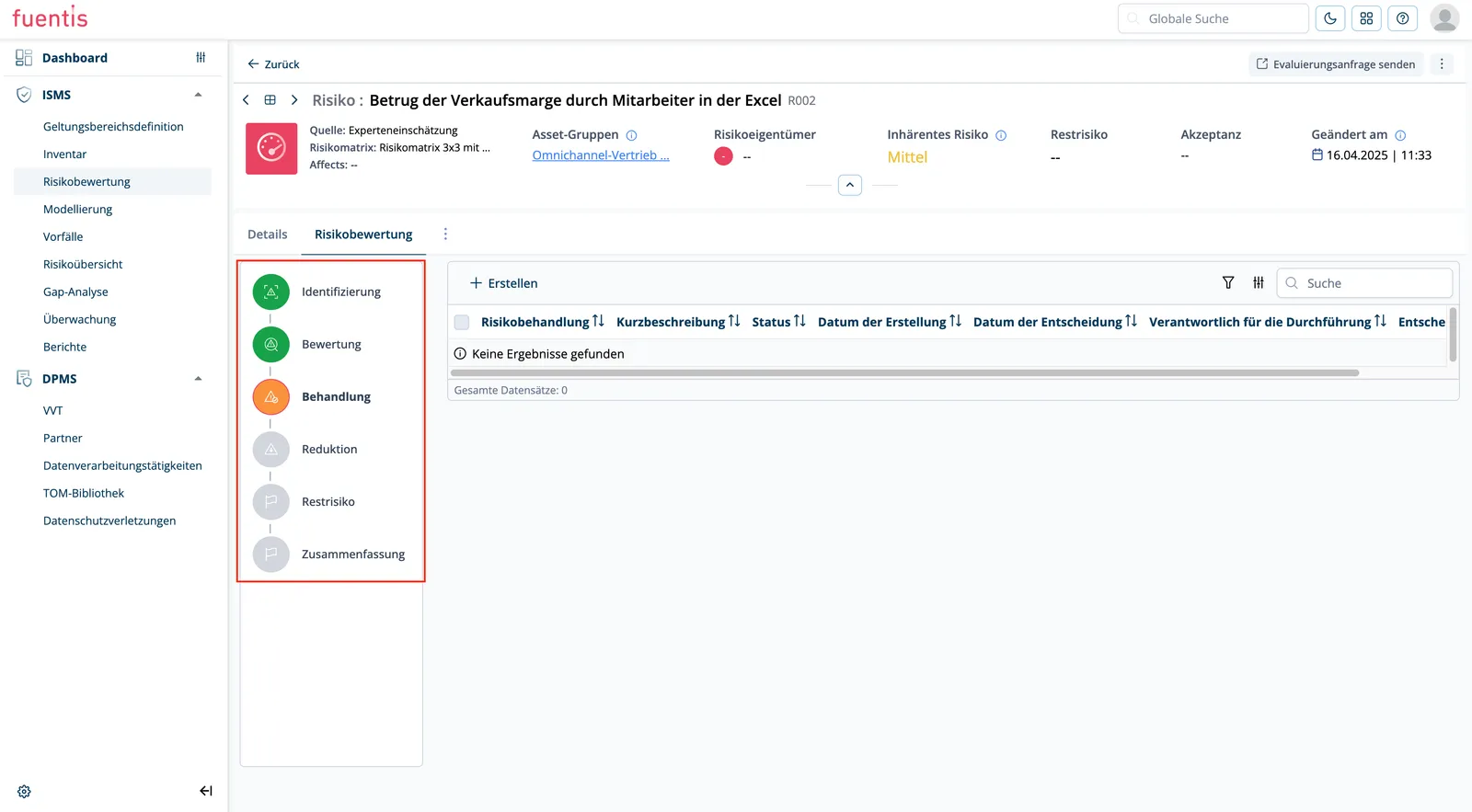
The 5-Step Workflow
Section titled “The 5-Step Workflow”-
Risk Identification (Yellow)
- Assign threats
- Document vulnerabilities
- Define damage scenarios
-
Risk Assessment (Yellow)
- Determine inherent risk
- Define target risk
- Complete documentation
-
Risk Treatment (Yellow)
- Choose strategy
- Plan measures
- Assign responsibilities
-
Risk Mitigation (Yellow)
- Implement controls
- Execute measures
- Monitor status
-
Residual Risk (Green = Completed)
- Assess residual risk
- Obtain acceptance
- Complete documentation
Color Coding:
- Green: Step completed
- Yellow: In progress
- Gray: Not yet started
Authorization Concept
Section titled “Authorization Concept”Global Role: ISMS_RISKS_ANALYSIS_ACCESS
- Basic requirement for access to risk analysis
Granular Permissions:
- Risks - Read/Create/Edit/Delete
- Threats - Assign/Edit/Delete
- Measures - Create/Edit/Delete
- Controls - Assign/Edit/Delete
- Vulnerabilities - Create/Edit/Delete
Glossary
Section titled “Glossary”Asset: Any value to the organization (hardware, software, data, processes, personnel)
Control: Security measure for risk mitigation (technical, organizational, physical)
CVE: Common Vulnerabilities and Exposures - database of known vulnerabilities
GRC: Governance, Risk Management, and Compliance
Inherent Risk: Risk without consideration of controls
Residual Risk: Remaining risk after implementation of measures
SoA: Statement of Applicability - applicability statement for ISO 27001
TOG: Target Object Group - grouping of similar assets in the ISMS
Target Risk: Desired/acceptable risk level