

Role-Based Access Control (RBAC)
Role-Based Access Control (RBAC) is the foundation for secure and efficient rights management in Information Security Management Systems. The fuentis Suite 4 implements a comprehensive RBAC concept that not only meets regulatory requirements but also enables practical work with different organizational structures and tenants.
Why is RBAC relevant?
- Compliance requirements
- Principle of least privilege: Each user receives only the rights they need for their tasks
- Auditability: Clear traceability of who can access which information
- Scalability: Efficient management even with complex organizational structures
Core Concepts of the RBAC System
Section titled “Core Concepts of the RBAC System”The Three Pillars of Rights Management
Section titled “The Three Pillars of Rights Management”1. Entities
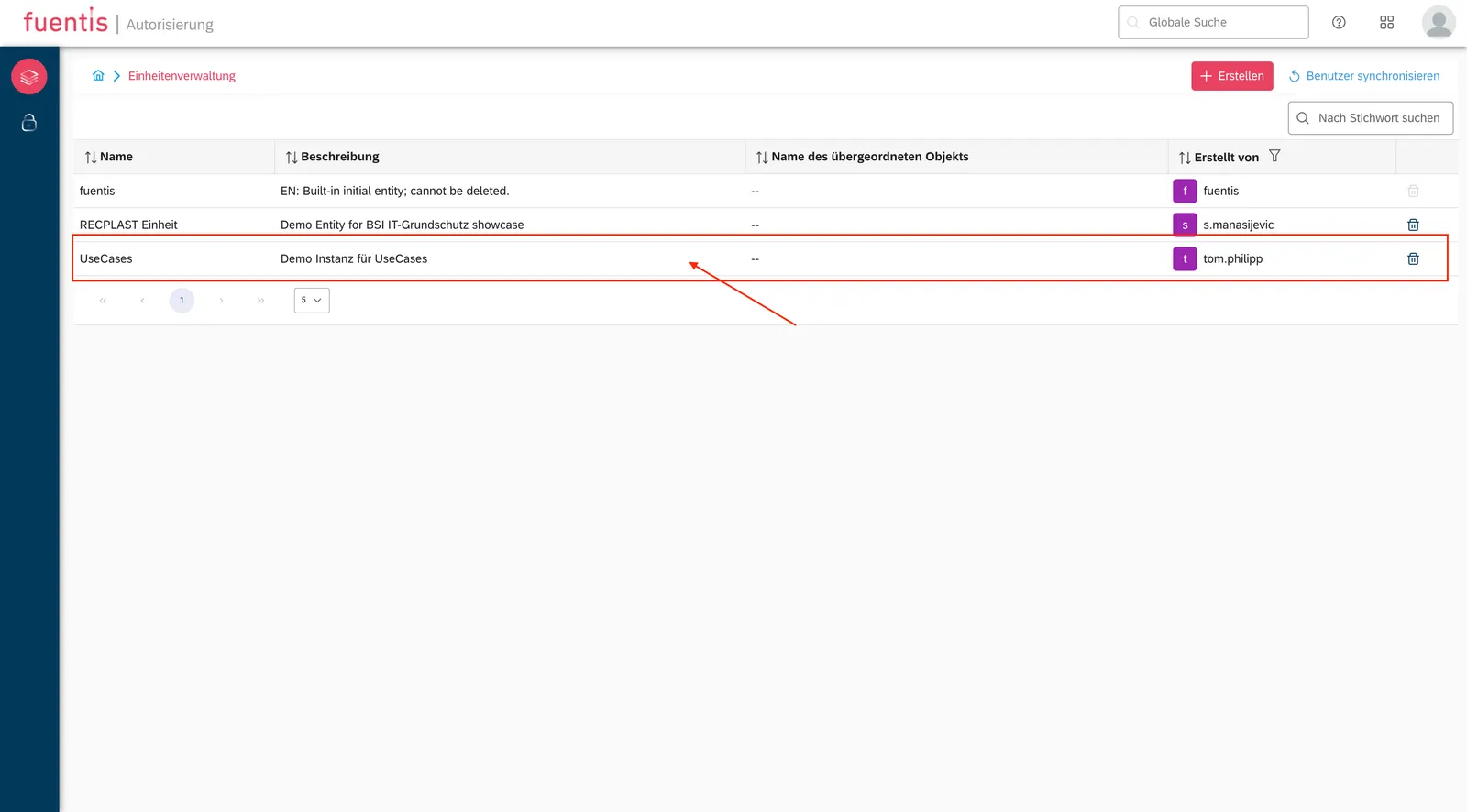
Section titled “1. Entities”Entities map the organizational structure of your company. They serve as:
- Logical separation of users and roles
- Organizational levels (e.g., corporate headquarters, national organizations, departments)
- Basis for multi-tenancy
Practice Tip: Use a consistent naming convention for entities, e.g.,
[Level]_[Location]_[Function]likeHQ_GLOBALfor corporate headquarters orUNIT_DE_FINANCEfor the German finance department.
2. Roles
Section titled “2. Roles”The system distinguishes two role types:
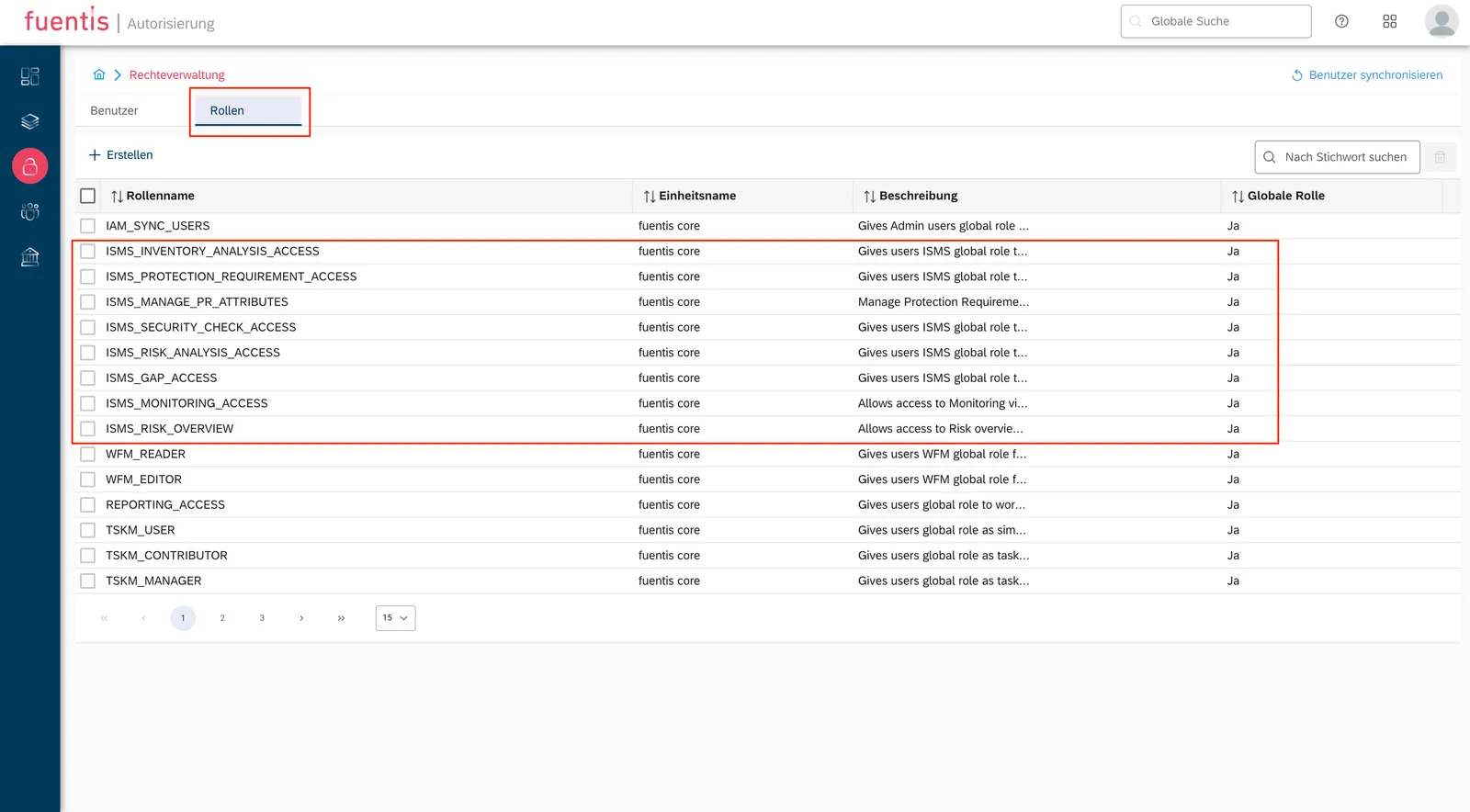
Global Roles
- Predefined, non-editable permission sets
- Apply across entities
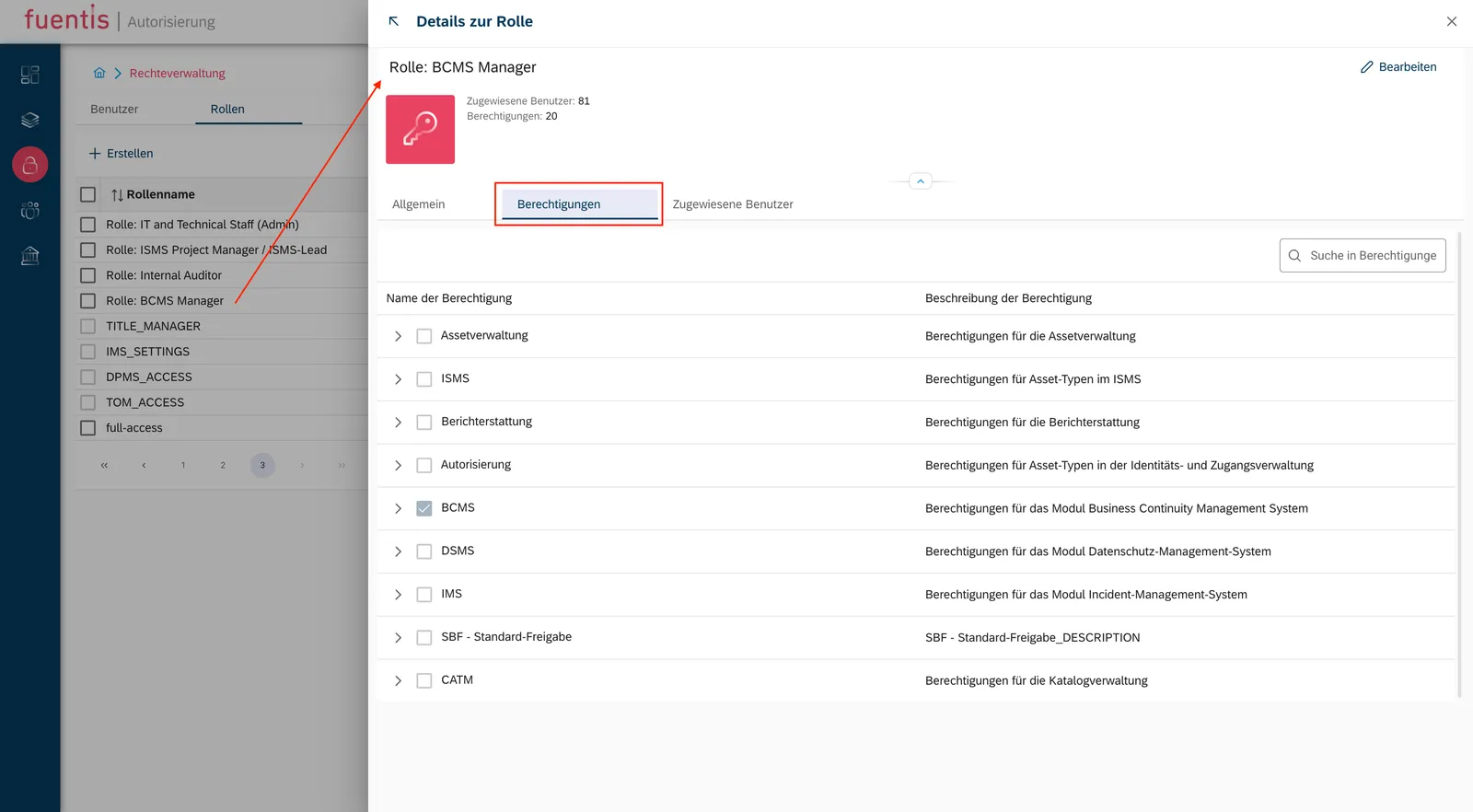
- Examples from fuentis Suite 4:
ISMS_INVENTORY_ANALYSIS_ACCESS: Access to inventory analysesISMS_RISK_ANALYSIS_ACCESS: Work with risk analysesWFM_EDITOR: Workflow editingTSKM_MANAGER: Task management with board functionsCATM_READER/EDITOR: Catalog managementASSM_INTEGRATION_MANAGER: Configuration of external integrations
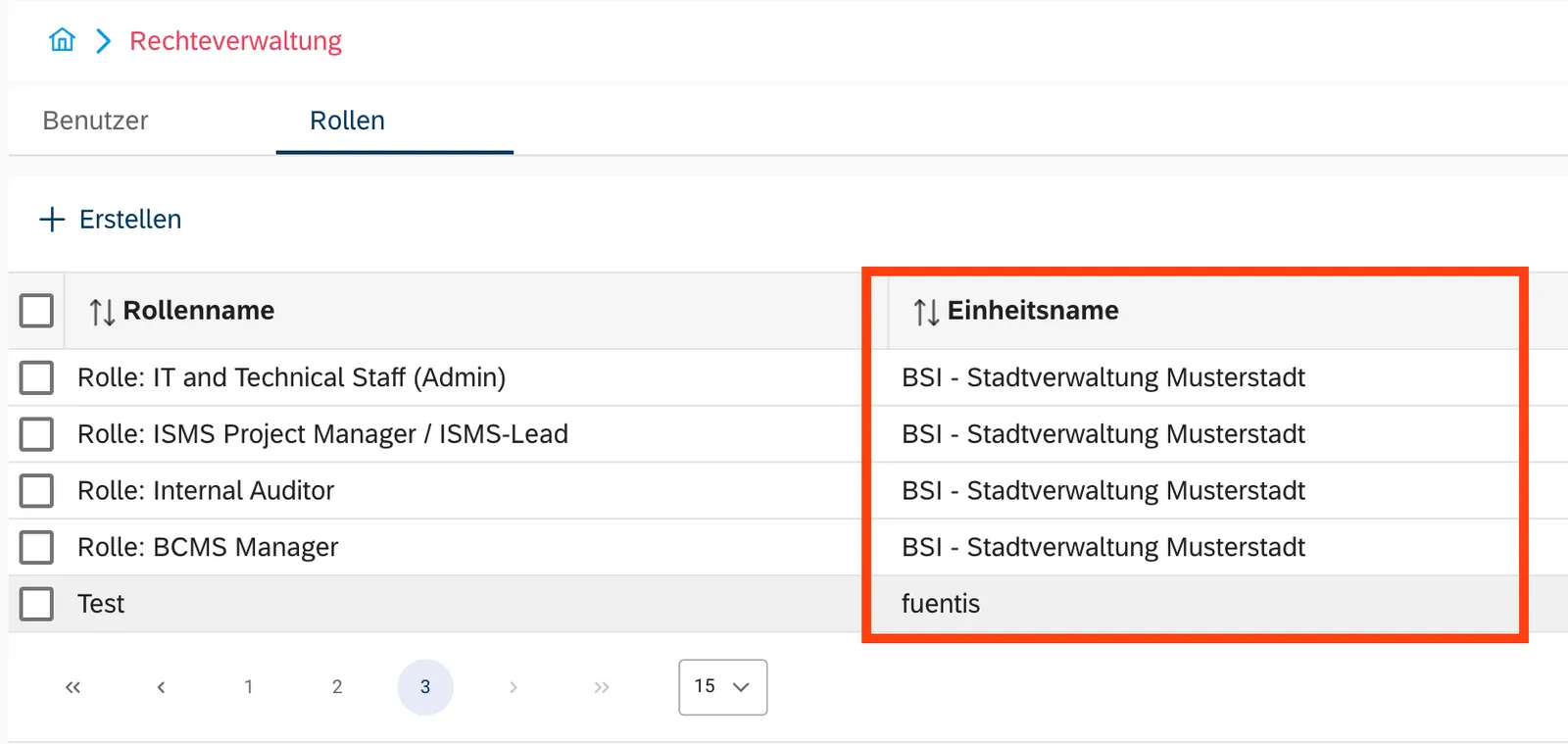
Custom Roles
- Flexibly customizable permissions
- Entity-specific assignable
- Ideal for fine-tuning access rights
3. Users
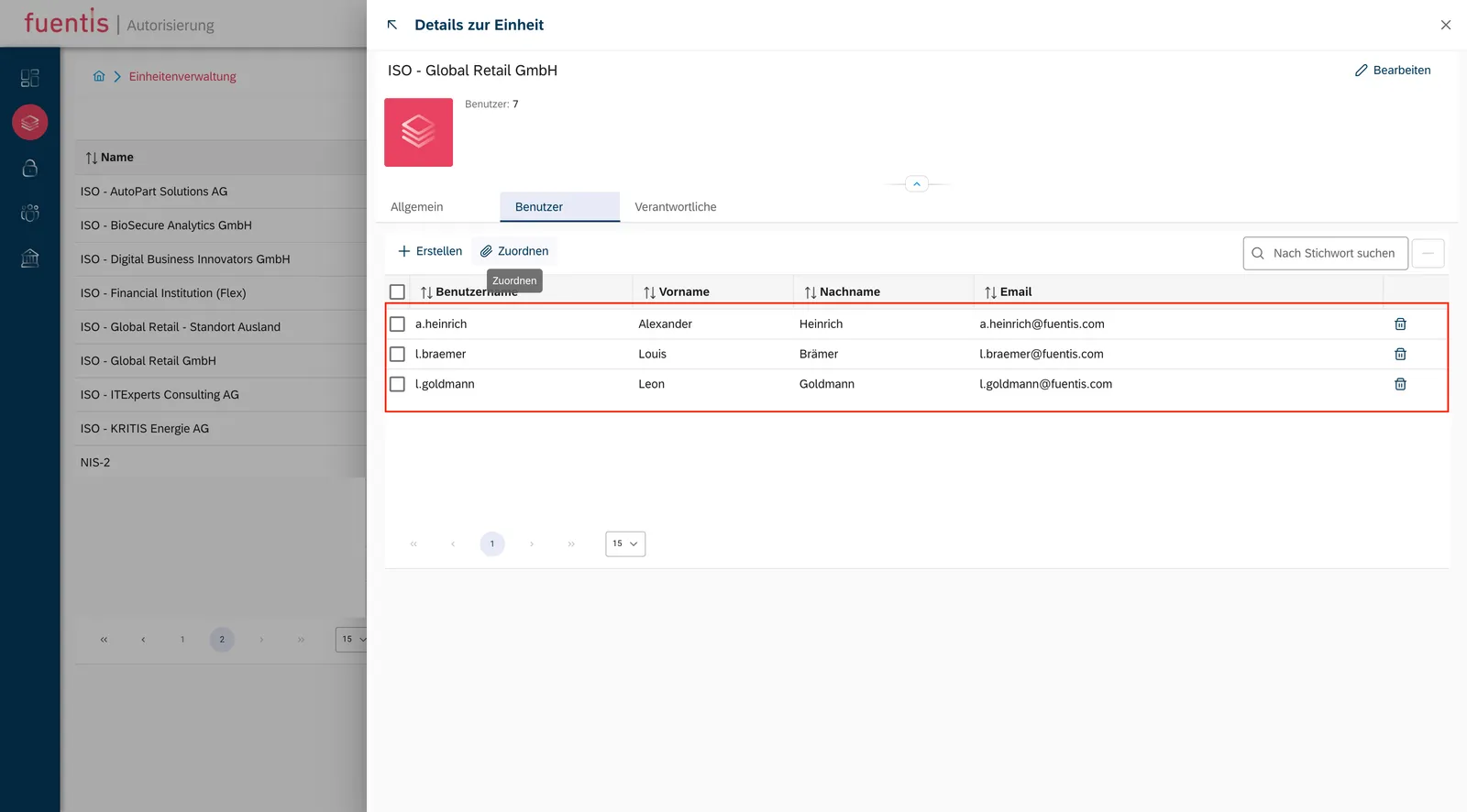
Section titled “3. Users”Users are:
- Managed via Keycloak as central authentication service
- Assigned to one or more entities
- Provided with global and/or entity-specific roles
Scopes and Multi-Tenancy
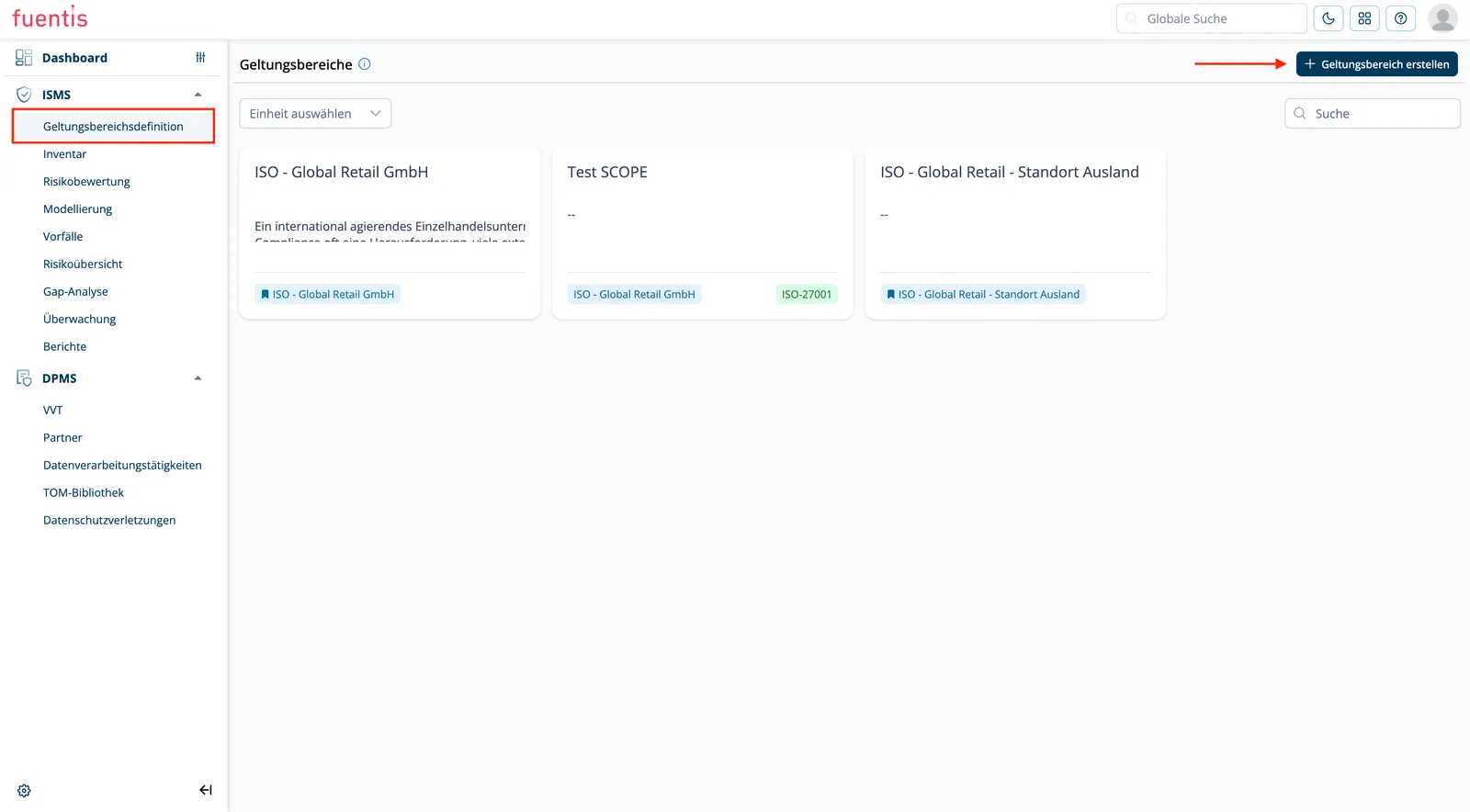
Section titled “Scopes and Multi-Tenancy”Scopes extend the concept of entities:
- Each entity has at least one scope
- Enable granular separation within an entity
- Basis for mapping information networks according to BSI IT-Grundschutz
Multi-Tenancy (Spaces) enables:
- Complete data isolation between tenants
- Individual configurations per tenant
- Cross-tenant access for collaborative work (controlled)
Practical Implementation of the RBAC Concept
Section titled “Practical Implementation of the RBAC Concept”User Lifecycle Management
Section titled “User Lifecycle Management”Onboarding Process
Section titled “Onboarding Process”- Application: Formal request via IT service portal
- Approval workflow: CISO/ISB approval required
- Account creation:
- Option A: Directly in Keycloak with subsequent synchronization
- Option B: Via entity management with automatic email notification
- Role assignment: Based on task profile
- Training & documentation: Proof of briefing
Offboarding Process
Section titled “Offboarding Process”- Deactivation request: Upon departure/contract termination
- Immediate access revocation: At termination date
- Monthly cleanup: Review of inactive accounts
RACI Matrix for Typical User Groups
Section titled “RACI Matrix for Typical User Groups”| Role | Responsible | Accountable | Consulted | Informed |
|---|---|---|---|---|
| CISO | ✓ | ✓ | ✓ | ✓ |
| ISB | ✓ | ✓ | ✓ | ✓ |
| External Auditor | - | - | ✓ | ✓ |
| Inventory Manager | ✓ | - | ✓ | ✓ |
| Risk Owner | ✓ | - | ✓ | ✓ |
| IT Admin | ✓ | ✓ | - | ✓ |
| Task Manager | ✓ | ✓ | ✓ | ✓ |
Module Permission Matrix
Section titled “Module Permission Matrix”The fuentis Suite 4 structures permissions modularly:
ISMS Module
Section titled “ISMS Module”Structural Analysis
- Scopes: Read (SL), Edit (SB), Delete (FA)
- Target object groups: Full access for administrators
- Asset links: Limited editable
Protection Requirements Analysis
- Protection requirement values: Editing by SiKo editors
- Recommendations: Only usable by administrators
- Distribution: Administrator rights required
Modeling
- Building blocks/requirements/measures: Read access for all, editing from SB
- Custom elements: Creation from SiKo editor role
- Import/Export: Permission for editors and higher
Risk Analysis
- Threats/risks: Complete management from SB role
- Risk matrices: Exclusively administrators
- Controls: Assignment by editors, management by admins
Practice Tip: Define role profiles for recurring task areas. Example: A “Risk-Analyst” profile could combine the roles
ISMS_RISK_ANALYSIS_ACCESS,ISMS_GAP_ACCESSandREPORTING_ACCESS.
Best Practices for RBAC Implementation
Section titled “Best Practices for RBAC Implementation”1. Map Organizational Structure Cleanly
Section titled “1. Map Organizational Structure Cleanly”- Use hierarchical entities for corporate structures
- Use scopes for functional separation
- Apply naming conventions consistently
2. Optimize Role Assignment
Section titled “2. Optimize Role Assignment”- Strictly follow principle of least privilege
- Conduct regular reviews (quarterly)
- Avoid overlapping roles
- Document deputy arrangements
3. Safely Integrate External Users
Section titled “3. Safely Integrate External Users”- Use separate roles with
_EXTsuffix - Set up time-limited access
- Ensure NDAs before granting access
- Activate audit trail for external access
4. Manage Multi-Tenant Environments
Section titled “4. Manage Multi-Tenant Environments”- Ensure data separation through separate spaces
- Cross-tenant access only targeted and documented
- Implement tenant-specific workflows
5. Monitoring and Compliance
Section titled “5. Monitoring and Compliance”- Regularly evaluate access logs
- Document permission changes traceably
- Establish recertification of permissions
- Monitor segregation of duties (SoD)
Technical Implementation in fuentis Suite 4
Section titled “Technical Implementation in fuentis Suite 4”Keycloak Integration
Section titled “Keycloak Integration”- Single Sign-On (SSO) for all modules
- LDAP/Active Directory connection possible
- Two-factor authentication optionally activatable
- Password policies centrally manageable
Synchronization and Consistency
Section titled “Synchronization and Consistency”- User sync between Keycloak and fuentis Suite
- Role propagation across all modules
- Caching mechanisms for performance optimization
Common Challenges and Solution Approaches
Section titled “Common Challenges and Solution Approaches”Problem: Complex Corporate Structures
Section titled “Problem: Complex Corporate Structures”Solution: Use hierarchical entities with inherited permissions. Parent units can define default roles for child units.
Problem: Temporary Project Access
Section titled “Problem: Temporary Project Access”Solution: Implement time-controlled roles with expiration date. Automatic deactivation after project end.
Problem: Compliance Evidence
Section titled “Problem: Compliance Evidence”Solution: Activate full audit log. Export permission matrix for audits.
Problem: Performance with Many Users
Section titled “Problem: Performance with Many Users”Solution: Role-based caching strategies. Asynchronous permission checks for non-critical operations.
Key Messages at a Glance
Section titled “Key Messages at a Glance”RBAC is mandatory: No ISO 27001 certification without structured rights management
Three-pillar principle: Entities + Roles + Users = complete access control
Flexibility through hierarchy: Global roles for basic functions, custom roles for special cases
Multi-tenancy ready: Complete tenant separation with collaboration option
Compliance by design: Automatic audit trails and traceable permission assignment
Additional Resources:
- Video Tutorial: RBAC Introduction